

Admiral - A History
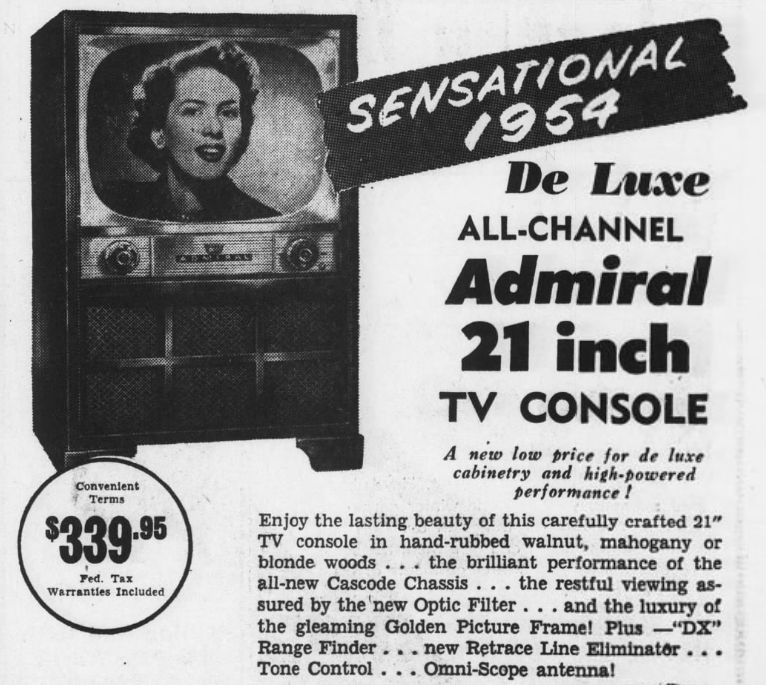
Admiral 1954 Television Ad
Admiral Corporation was founded in 1934 by Ross D. Siragusa, an Italian immigrant, in Chicago, Illinois. Starting with just $3,400 in capital and operating out of a friend's garage, Siragusa established the Continental Radio and Television Corporation, manufacturing radios aimed at working and middle-class consumers at prices lower than competitors like RCA and Zenith. In 1936 he purchased the "Admiral" trademark for just $200, and the name eventually became the official identity of the company after World War II.
The company grew rapidly through the late 1930s, with sales topping $9 million by 1939. During World War II, Admiral pivoted to manufacturing military electronics under government contracts, which further accelerated its growth and capabilities. After the war, Admiral moved aggressively into television production, manufacturing 400,000 sets in 1949, over one million in 1950, and an astonishing five million in 1951, making it one of the leading TV manufacturers in America alongside DuMont and Philco.

Admiral 1948 Radio Ad
One of Admiral's greatest achievements came on December 30, 1953, when it introduced the world's first commercially available color television, the C1617A, priced at $1,175. The company also became one of the earliest major advertisers on television itself, sponsoring programs such as Sid Caesar's Your Show of Shows and using the memorable slogan "America's Smart Set." By 1966, Admiral employed over 14,000 people, operated in 110 countries, and posted sales of $414 million — a remarkable rise from its humble garage origins.
The 1960s and early 1970s, however, brought serious challenges. Increased foreign competition, particularly from Japanese manufacturers flooding the market with cheaper products combined with outdated production facilities sent the company into financial decline. By the early 1970s Admiral was operating at a loss and seeking a buyer.
In 1974, Rockwell International acquired Admiral, marking the end of the company's life as an independent manufacturer. Rockwell had little interest in the consumer electronics side of the business and moved to shut it down. Television and radio production wound down through the mid-1970s, with Admiral's last TV manufacturing plant closing in 1979.
Rockwell sold the appliance division — refrigerators, washers, dryers, ranges, and air conditioners — to Magic Chef in 1979, under whom the business briefly stabilized. Magic Chef was then acquired by Maytag in 1986 for $740 million, bringing Admiral's appliance operations along with it. Under Maytag, the Admiral brand continued as a functioning appliance line, but the pace of new product development slowed considerably. When Whirlpool purchased Maytag in 2006, Admiral became little more than a budget label sold exclusively at Home Depot, with only a handful of washers and dryers carrying the name before those too were eventually discontinued.
From a garage in Chicago to a global electronics powerhouse, and ultimately a faded brand name, Admiral's story mirrors the broader rise and fall of American consumer electronics manufacturing in the twentieth century.
Farnsworth - A History
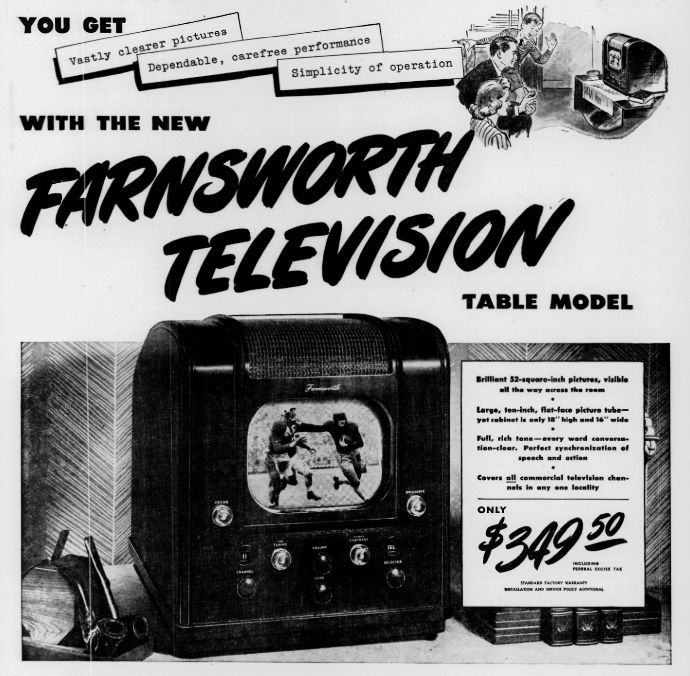
Farnsworth Television Ad 1947
The Farnsworth Television and Radio Corporation was founded in 1938 in Fort Wayne, Indiana, when inventor Philo T. Farnsworth and his investors purchased the assets of the Capehart Automatic Phonograph Company. Farnsworth deliberately retained the Capehart name because the former company carried a strong reputation for quality radio and phonograph manufacturing — a reputation he intended to leverage as the foundation for his entrance into consumer electronics. The main facility was located at 3702 East Pontiac Street, and it became what is recognized as the site of the first mass production of television sets in the United States.
Beginning in 1939 the plant produced radios and phonographs under both the Farnsworth and Capehart brand names, with a third line — Panamuse — used for radio-phonograph combinations. The company also manufactured television transmitters, receivers, and cameras, with Farnsworth's vision being not merely to sell television sets but to build a vertically integrated broadcasting business. To that end he acquired Fort Wayne radio station WGL, intending it as the foundation for an eventual television network — a venture he believed would ultimately prove more lucrative than manufacturing alone.
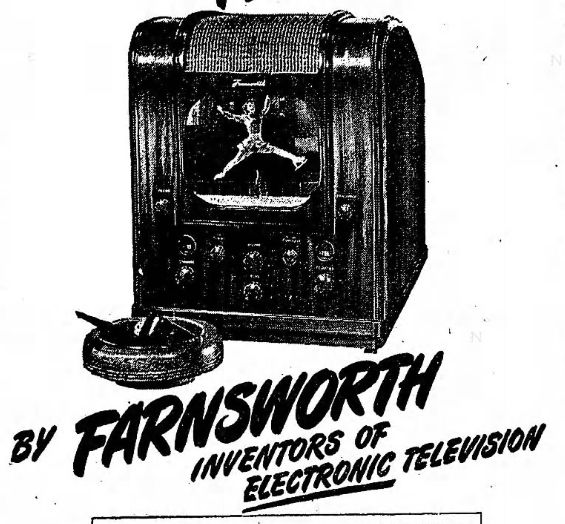
Farnsworth Ad Excerpt 1948
That vision never got off the ground, because almost immediately after the Fort Wayne plant opened, the United States entered World War II. Consumer television and radio production was halted by federal order, and the company converted its factories entirely to military work. At its wartime peak the company operated seven factories across Indiana, producing radio communication equipment, radar systems, and missile guidance technology. To fund the expansion the company took out substantial government loans — a decision that would prove catastrophic when the war ended and the loans came due almost immediately.
The company produced its first consumer television set in 1947. The timing was devastating. That same year, Farnsworth's core patents — filed back in 1927 — expired. The window he had spent nearly two decades fighting to reach had finally opened, and he had nothing left to protect what was inside it. Meanwhile, RCA, Philco, and other well-capitalized rivals had used their superior resources and FCC connections to position themselves at the front of the postwar television boom. The Farnsworth company, burdened with war debt, stripped of patent protection, and outgunned in the scramble for postwar parts and materials, found itself financially unable to compete.
In 1949, the board of directors voted to sell the company to International Telephone and Telegraph — ITT — which reorganized the operation as Capehart-Farnsworth. Philo Farnsworth was retained as vice president of research but had no ownership or control over the business he had built. ITT refocused the Fort Wayne facility primarily on defense and aerospace electronics, and while the Capehart-Farnsworth name continued producing consumer televisions until 1965, that was ITT's enterprise, not Farnsworth's.
As an independent manufacturer, the Farnsworth Television and Radio Corporation existed for just eleven years — from 1938 to 1949. Of those eleven years, four were consumed by wartime military production. Its first consumer television set came out the same year its patents ran out. The company that invented television never got to sell it.
Magnavox - A History
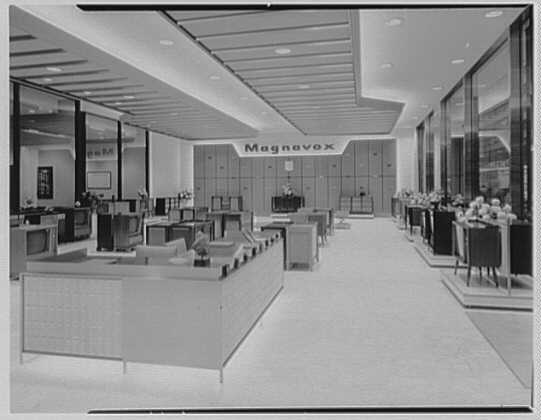
Magnavox Store on 48th Street in NYC, 1960
The story of Magnavox begins not in a factory but in a laboratory — a small, 800-square-foot space in Napa, California, where in 1911 two inventors named Peter L. Jensen and Edwin Pridham were working to solve a problem the telephone industry had failed to crack: how to project the human voice loudly enough to reach a crowd. What they produced was the world's first moving-coil loudspeaker, a device so effective that when they demonstrated it publicly in 1915, it was the first time in history a single voice could be heard by an entire town. They called it Magnavox — Latin for "great voice" — and the company that grew from it would eventually bring that voice into millions of American living rooms.
The formal Magnavox Company was established on July 5, 1917, following a merger with the Sonora Phonograph Distributing Company. Through the 1920s the company manufactured speakers, radios, and phonograph components, supplying parts to other manufacturers including Crosley. In 1931 manufacturing relocated to Fort Wayne, Indiana, placing the company at the center of the country's copper wire production and closer to its major markets.

The Magnavox Odyssey — the world's first home video game console
The pivot that defined Magnavox's identity as an independent manufacturer came in 1938, when it merged with Electro Acoustics Products, a small Chicago sound company, bringing aboard its founder Frank Freimann as vice president. Freimann convinced the company to abandon its focus on components and instead commit fully to complete consumer products — a strategic shift that proved transformative. In 1950 he became president, launching what the company's own historians would later call the "glory years." Under Freimann's leadership Magnavox positioned itself as America's premium consumer electronics brand — not the cheapest option, but the best, sold through carefully selected dealers and priced accordingly.
During World War II Magnavox converted entirely to military production and became the first electronics manufacturer honored by the U.S. Navy with its "Navy E" award in February 1942, recognizing excellence in war production. Its work in radar, sonar, and military communications established a deep defense electronics capability that would run alongside its consumer business for decades.
Magnavox built its first consumer television set in 1948 — the model MV-10 — and by 1962 had constructed Plant #3 in Greeneville, Tennessee, at the time the largest television manufacturing plant under one roof in the country. In the 1960s the company manufactured the first plasma displays for military and computer applications. Then in 1972 came the achievement that secured Magnavox's permanent place in technology history: the Magnavox Odyssey, the world's first commercial home video game console, developed by Ralph Baer and licensed from defense contractor Sanders Associates. It launched an entire industry.
Freimann died in 1968, and without his strategic clarity the company lost its footing. In 1974 North American Philips Corporation acquired Magnavox — ending its life as an independent manufacturer. Though North American Philips had long operated on American soil, it was not an American company in any substantive sense. It had been created in the late 1930s as a legal refuge for the Dutch electronics giant Philips N.V. — founded in 1891 in Eindhoven, Netherlands — anticipating Nazi occupation of the Netherlands, which came in May 1940.
After the war, rather than dissolving back into the Dutch parent, the American structure was maintained for decades as what Forbes magazine bluntly called in 1969 "a monument to man's ability to maintain a legal fiction despite its obvious unreality." In 1987 the pretense officially ended and Magnavox became a wholly owned subsidiary of the Dutch firm. Philips merged Magnavox, Philco, and Sylvania into a single division, and the last television manufactured under the Magnavox name in America rolled off the Greeneville line in July 2005.
Philco - A History

Philco Predicta Television
Philco's story begins in Philadelphia in 1892, as far from the electronics business as imaginable. Founded originally as Helios Electric Company to manufacture carbon-arc lamps, the company reinvented itself as the Philadelphia Storage Battery Company in 1906 when the lamp market collapsed, pivoting to making batteries for electric vehicles. It was a pattern of survival through reinvention that would define the company for decades. The Philco brand name first appeared in 1919, the product of an internal naming contest.
The pivot that made Philco famous came in 1928. Vice-President and General Manager James M. Skinner — a University of Pennsylvania chemist who had joined the company in 1911 and was its true driving force — recognized that the exploding demand for home radios represented an entirely new market. Rather than following existing manufacturers into hand-built, expensive sets aimed at wealthy buyers, Skinner applied automobile assembly line techniques to radio manufacturing, slashing costs and targeting the mass market. Philco produced 96,000 radios in the second half of 1928 alone. By the end of 1930 it was the number one radio seller in America — a position it held for over twenty years. By 1934, Philco commanded 34 percent of the entire domestic radio market, the iconic cathedral-style Baby Grand radio selling over two million units.

Philco TV Ad 1964
Philco's connection to television history is direct and personal. Philo Farnsworth — the inventor of electronic television — worked at Philco from 1931 to 1933, and the company began television research that same year, establishing experimental station W3XE in 1932. In 1941 that station became the third commercially licensed television station in the United States. Philco also expanded into car radios in 1930, air conditioners in 1938, and refrigerators in 1939, building one of the broadest consumer electronics and appliance lines in American industry.
During World War II, Philco converted to military production, eventually ranking 57th among all American corporations in the value of wartime contracts — deep enough in the government relationship ecosystem to emerge from the war with its manufacturing base intact, its commercial television license already in hand, and its engineering talent employed and improving throughout the conflict. It began full mass production of consumer television sets in 1947 and pioneered the surface-barrier transistor in 1953, the first commercial transistor capable of operating at very high frequencies.
The decline that followed was a leadership story as much as a market story. Skinner, the disciplined founder who had opposed taking the company public and believed in doing one thing deeply rather than many things broadly, departed in 1939 after a policy dispute over that very question. The men who replaced him took Philco public in 1940 and spent the following two decades chasing growth in every direction simultaneously — refrigerators, ranges, freezers, transistors, computers, European expansion, acquisitions of Bendix and Crosley. Earnings plummeted from $335 million in 1950 to just $2.3 million in 1960. Ford Motor Company purchased Philco in December 1961 for $75 million. The name was changed to Philco-Ford in 1966. Ford sold it to GTE in 1974, and Philips acquired the brand name in 1981.
Westinghouse - A History
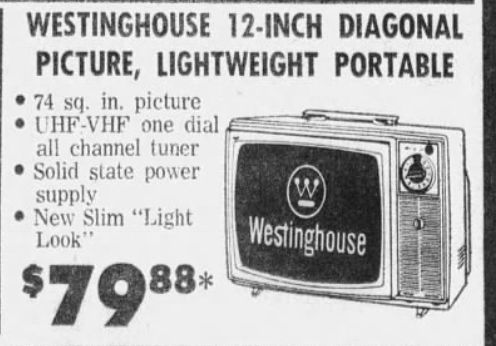
Westinghouse TV Ad 1968
George Westinghouse, who invented the air-brake as a 22-year-old engineer with little formal education, founded the Westinghouse Electric Company in Pittsburgh in 1886 with a single audacious ambition: to challenge Thomas Edison's direct current monopoly by proving that alternating current could power the world. He succeeded. Westinghouse installed the nation's first AC power system in 1891, powered the Chicago World's Fair in 1893, and won the contract to harness Niagara Falls. The company boasted 50,000 employees by 1900 — a staggering figure for the era — and established a formal research and development department in 1906 that would generate innovations across nearly every field of electrical engineering for the next century.
Consumer electronics entered the picture through broadcasting. On November 2, 1920, KDKA began scheduled programming with the Harding-Cox presidential election returns — the first commercial radio broadcast in history, transmitting from a shed atop the Westinghouse plant in East Pittsburgh. Westinghouse had realized that continuous broadcast service would help receiver sales, and KDKA was as much a marketing vehicle for radio sets as a public service. The strategy worked, and through the 1920s and 1930s Westinghouse became a significant manufacturer of radios, consumer appliances, refrigerators, and washing machines.
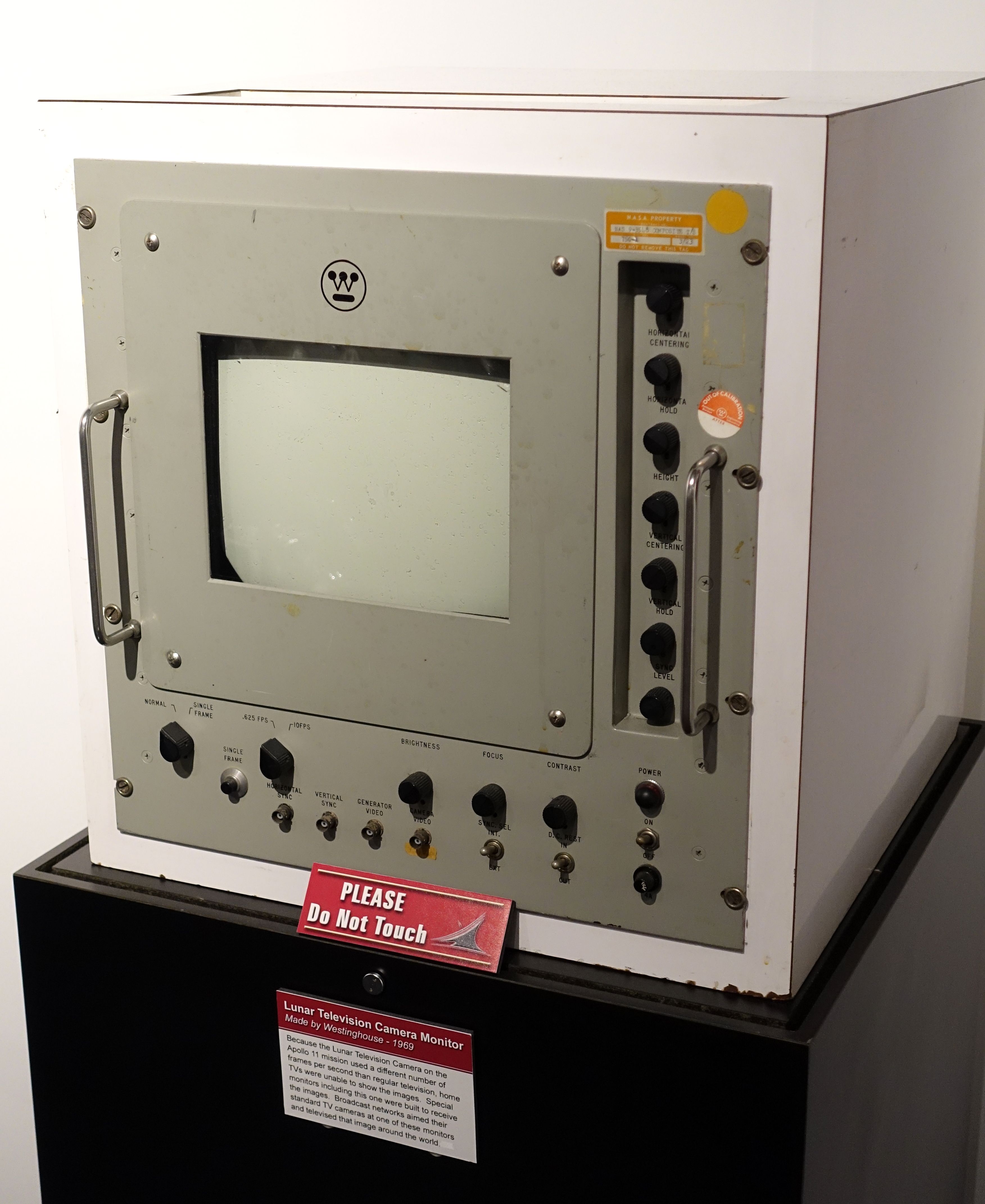
Westinghouse Lunar Television Camera Monitor
Television was a category Westinghouse should have owned but fumbled through institutional indifference. Vladimir Zworykin, the inventor of the electronic picture tube, began his research at Westinghouse in the early 1920s, but his superiors showed indifference to his work, and when David Sarnoff was able to woo him to RCA, Zworykin filed the patent that would form the basis for the modern television set there. It was one of the most consequential acts of institutional negligence in American technology history. Westinghouse did eventually manufacture televisions, and in March 1954 produced the H840CK15 — technically the first color television set offered for sale to American consumers, though only a handful were actually sold before larger, cheaper sets from RCA and Motorola made it obsolete within months.
What distinguished Westinghouse from every other company in this series was its breadth. It was never primarily a consumer electronics company — it was a vast industrial conglomerate that happened to also make radios, televisions, and appliances alongside nuclear reactors, defense radar systems, military jet engines, and industrial turbines. Westinghouse produced the first electric range in 1917, developed the first all-electric television cathode ray tube from 1929 to 1931, made the first working American turbojet engine for the U.S. Navy in 1943, and constructed the first civilian nuclear power plant at Shippingport, Pennsylvania in 1957. Consumer electronics were a substantial business but never the core of what the company was.
That breadth became a liability as each business line came under pressure in succession. Westinghouse consistently lagged behind General Electric in home appliance sales and basically ceased competing in that market in 1975, selling the entire appliance division to White Consolidated Industries the year before, creating the White-Westinghouse brand. Television manufacturing ceased the same year. Then the nuclear disaster arrived: uranium prices skyrocketed in 1975, Westinghouse reneged on fuel supply agreements, and 27 utility companies sued, with potential liabilities exceeding two billion dollars. The Three Mile Island accident in 1979 further destroyed the nuclear order book. Through the 1980s, Westinghouse sold its lamp division to Philips in 1983, its elevator division to Schindler in 1988, and its transmission and distribution business to ABB in 1989.
The final act was the strangest in American corporate history. Rather than rebuilding, in 1995 Westinghouse bought CBS for $5.4 billion, pivoted entirely to broadcasting, sold off every remaining industrial and defense operation, and in 1997 renamed itself CBS Corporation. The name George Westinghouse had placed on the first AC power system, the first commercial radio broadcast, and the first color television was erased and reduced to a brand license — today used on Chinese-manufactured LCD televisions that bear no connection to anything the company ever built.
Zenith - A History

Zenith Sign at its Corporate HQ in 1995
Zenith's beginnings were very modest. Two ham radio operators, Karl E. Hassel and R.H.G. Mathews, began manufacturing radio equipment at a kitchen table in 1918 under the name Chicago Radio Laboratory. Their call sign was 9ZN — shortened to Z-Nith, and eventually Zenith. The two were joined in 1921 by Eugene F. McDonald Jr., a driven, flamboyant former Navy commander who was already a self-made millionaire. In 1923 the company was incorporated as Zenith Radio Corporation, with 30,000 shares of stock issued at $10 per share, the largest single block going to McDonald. For the next 35 years, in the public mind, McDonald was Zenith — its creative engine, its relentless innovator, and its stubborn insistence that quality came before price.
Under McDonald, Zenith pioneered the first portable radio in 1924, the first push-button radio in 1927, the first all-electronic television station in 1939, and the first FM radio station in the Midwest in 1940. During World War II the company pivoted to hearing aids — a miniaturized radio receiver that retailed at $40 and made hearing assistance affordable for the first time — and became the largest marketer of hearing aids in the world, outselling all other companies combined.

Zenith Data Systems Keyboard
Zenith sold its first black-and-white television set in 1948, the same year it acquired the Rauland Corporation, a Chicago-based picture tube manufacturer. That first set — the 27T series — was a porthole-style console with a round 12-inch CRT set into a mahogany cabinet, built entirely in Chicago with picture tubes Zenith made itself. The innovation that most permanently attached the company's name to American living rooms followed in 1950, when Zenith introduced the Lazy Bones — the first television remote control of any kind, using a cable that ran from the TV set to the viewer, allowing channel changes and power control without leaving the couch. Consumers loved the concept and complained about tripping over the cord. Zenith engineer Eugene J. Polley answered that complaint in 1955 with the Flash-Matic, the first wireless television remote, using a directional flashlight to activate photo cells in the corners of the TV screen. Engineer Robert Adler then replaced the flashlight with ultrasonic sound in 1956 — the Space Command — and the word "clicker" entered the American vocabulary from the sound those aluminum rods made.
Zenith also foresaw pay television with unsettling accuracy. The company developed the world's first subscription television system, known as Phonevision, as early as 1947, believing advertising-supported broadcasting alone could not sustain the medium. The FCC blocked its rollout for years. Pay television eventually became the dominant model for premium content, decades after Zenith had proved it worked. The company fought harder against the Japanese dumping campaign than any other American manufacturer. In 1974, Zenith filed a landmark antitrust suit claiming all seven major Japanese television manufacturers had conspired to raise prices in Japan while fixing artificially low prices for sets exported to the United States — a scheme allegedly begun as early as 1953. The case reached the Supreme Court, which dismissed it in 1986. By then the damage was irreversible. The arrival of John Nevin as president in 1971 — a Ford Motor Company executive with no roots in Zenith's engineering culture — marked the beginning of a long institutional retreat. Under Nevin, Zenith contracted with Sony to sell Betamax recorders under the Zenith label, moved production to Mexico and Taiwan, halved its R&D staff in 1977, laying off approximately 200 engineers, and hollowed out the technical depth that had defined the company. Nevin left in 1979 to engineer the sale of Firestone to Bridgestone of Japan. His successors continued the contraction.
By 1988 Zenith was the last American company still making televisions. It was a distinction earned through genuine engineering excellence — in 1994 the industry chose Zenith's transmission system as the U.S. standard for HDTV — but one that could not overcome decades of financial erosion. LG Electronics of South Korea acquired a controlling interest in 1995. Zenith closed its last U.S. manufacturing plant — the Melrose Park picture tube facility — in late 1998. The final sets Zenith manufactured came off Mexican assembly lines that same year before production passed entirely to LG. The company filed for bankruptcy in August 1999 and emerged as a wholly owned LG subsidiary in November of that year.
The contrast between first and last televisions Zenith produced says everything: a 1948 porthole television built in Chicago with tubes made in-house by a company owned by Americans, and a 1998 set assembled in Mexico by a company majority-owned by South Korea — both bearing the same lightning bolt logo and the same slogan: "The quality goes in before the name goes on."